



Table of Contents
- Short Answer: What Is Network Marketing?
- What Does Network Marketing Mean in Simple Terms?
- How Does Network Marketing Work?
- Is Network Marketing the Same as MLM?
- Examples of Network Marketing Companies
- Job vs Network Marketing: The Key Differences
- How Much Can You Make From Network Marketing?
- Potential Advantages of Network Marketing
- Practical Disadvantages and Risks
- Is Network Marketing a Pyramid Scheme?
- How to Evaluate a Network Marketing Company Before Joining
- How SEO and Digital Marketing Support Network Marketing
- Job or Network Marketing: Which Is Better for You?
- Final Verdict
- Frequently Asked Questions
The model itself is not difficult to understand. The difficult part is working out whether a particular opportunity has real customers, sensible costs and a compensation plan capable of producing profit without constant recruitment.
That is where this guide starts.
Short Answer: What Is Network Marketing?
Network marketing is a person-to-person sales model in which independent distributors sell a company’s products or services. In a multi-level marketing structure, commonly called MLM, a distributor may also sponsor other distributors and receive commissions linked to sales generated by that team.
The participant is generally not a salaried employee. Income usually depends on retail sales, commissions and the rules of the company’s compensation plan. Costs may include products, a starter kit, shipping, training, events, software, advertising and taxes.
Network marketing is not automatically an illegal pyramid scheme. However, the Federal Trade Commission’s consumer guidance warns that some MLMs are pyramid schemes and that most people who join legitimate MLMs make little or no money; some lose money.
So the useful comparison is not “salary versus unlimited income.” It is predictable employee compensation versus uncertain business profit after every expense.
What Does Network Marketing Mean in Simple Terms?
Imagine a company that chooses not to rely only on shops or an employed sales force. Instead, it signs up independent representatives who introduce products directly to customers—in person, through social media, on a personal website or by referral.
The representative can usually earn a retail margin or commission when a customer buys. In an MLM version of the model, the representative can also sponsor other sellers. Those sellers form a downline, while the person who sponsored them is part of their upline. Depending on the compensation plan, sales made across that network may contribute to bonuses or commissions.
That last detail is why the words surrounding network marketing can become confusing.
| Term | What it normally means | Main source of compensation |
|---|---|---|
| Direct selling | A broad category in which products or services are sold directly to consumers outside a fixed retail store | The seller's own retail sales |
| Network marketing | A relationship-led direct-sales model; the term is commonly used for MLM | Personal sales and, in multi-level plans, eligible team sales |
| Multi-level marketing (MLM) | A direct-selling structure with multiple levels of participants | Personal retail sales plus compensation linked to downline sales under the plan |
| Affiliate marketing | A publisher or creator sends tracked referrals to a merchant | Commission on attributable actions or sales, normally without inventory or a recruited downline |
| Business networking | Building professional relationships for referrals, learning or opportunities | No built-in compensation plan |
| Pyramid scheme | An illegal structure driven mainly by recruitment rewards rather than sustainable sales to real customers | Money or purchases flowing from later participants toward earlier ones |
Direct selling is therefore broader than MLM. A person can sell directly to customers without building a multi-level team. At the same time, changing the label from “MLM” to “network marketing” does not change how a compensation plan operates.
How Does Network Marketing Work?
The exact contract varies, but a typical process looks like this:
- A participant joins as an independent distributor. The company provides a distributor agreement, product access and a compensation plan. Some companies charge a joining or starter-kit fee; others do not.
- The distributor finds retail customers. Sales may happen through personal contacts, demonstrations, social media, email, a replicated company website or other permitted channels.
- The distributor earns from eligible sales. This may be a retail markup, a direct commission or another sales-based payment.
- The distributor may sponsor other participants. In an MLM, those participants can form a sales team or downline.
- Team sales may affect additional compensation. Bonuses can depend on sales volume, rank, active-customer rules and other conditions in the plan.
- The distributor pays business costs. The company may report gross payments, but the participant still needs to subtract expenses and deal with applicable taxes.
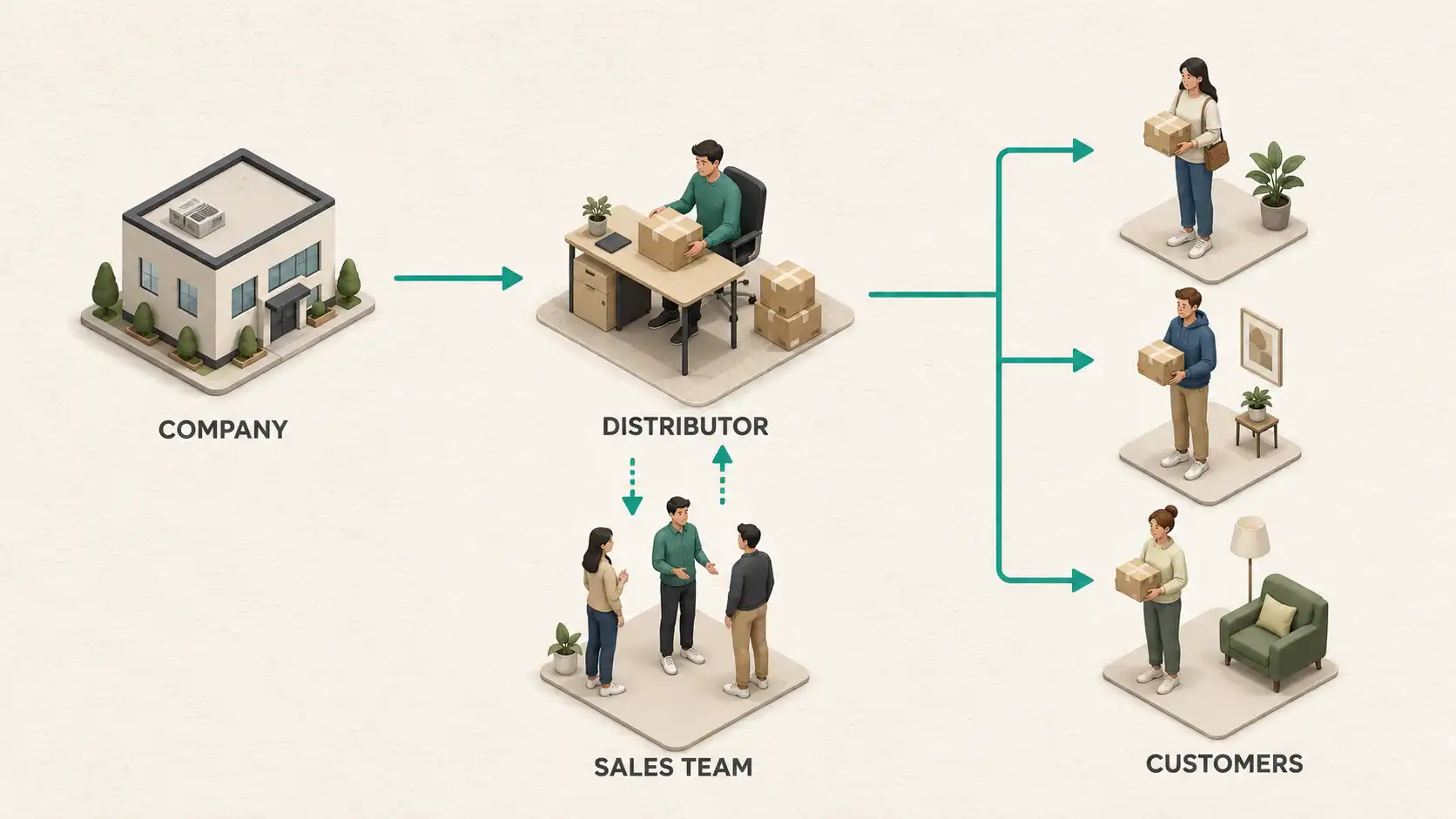
The basic flow is:
Company → independent distributor → retail customer
An MLM adds another possible layer:
Distributor → sponsored distributors → their retail customers
Recruiting a person is not the same as creating a customer. The central question is whether products are being sold because outside customers genuinely want them, or because participants must buy them to join, remain active or qualify for rewards.
Is Network Marketing the Same as MLM?
In everyday use, the terms are often treated as synonyms. The FTC itself describes businesses involving person-to-person sales and recruitment as “multi-level marketing,” “network marketing” or “direct marketing” businesses.
There is still a useful distinction:
- Direct selling can exist with no downline at all.
- MLM specifically adds multiple participant levels and team-linked compensation.
- Network marketing is sometimes used broadly for relationship-based selling, but it frequently refers to MLM in business-opportunity discussions.
For that reason, do not judge an opportunity by what it calls itself. Read how participants qualify for payments, what behavior the plan rewards and where real customer demand comes from.
Examples of Network Marketing Companies
Several established companies publicly describe themselves as direct-selling businesses that work through independent sellers:
- Amway calls its participants Independent Business Owners. Its official explanation says they can earn from retail margins, personal sales bonuses and eligible sales generated by people they sponsor.
- Herbalife says its independent distributors can earn retail profit and, when eligible, commissions and other incentives based on sales and business performance.
- Mary Kay describes direct selling through independent beauty consultants who serve customers in person and through digital channels.
These are examples of how companies describe their own models, not endorsements from this article. A familiar name also does not remove the need to review the current local contract, compensation plan, typical-earnings statement, costs and refund terms. Those details can differ by country and change over time.
Job vs Network Marketing: The Key Differences
A job and a network marketing opportunity are not two versions of the same arrangement. One is employment; the other is generally a commission-based independent business activity.
| Factor | Traditional job | Network marketing / MLM |
|---|---|---|
| Working relationship | You work for an employer under an employment agreement | You generally participate as an independent distributor or contractor |
| Main pay structure | Salary, hourly wage and possibly bonuses | Retail margin, commission and possibly team-sales bonuses |
| Income timing | Usually paid on a scheduled cycle | Depends on eligible sales, returns, plan rules and payout thresholds |
| Predictability | More predictable, although hours, bonuses and continued employment can change | Variable; there may be no payment in a period and expenses can exceed revenue |
| Upfront spending | A legitimate employer normally pays the employee; education, commuting or equipment costs can still exist | May involve a starter kit, products, samples, shipping, events, tools or advertising |
| Benefits | Full-time roles may include medical coverage, paid leave and retirement benefits | Distributors generally arrange and fund their own benefits |
| Schedule | Controlled partly or largely by the employer; remote and flexible jobs also exist | Often flexible, but customer needs, meetings, events and team support still consume time |
| Customer acquisition | The employer usually owns the product, brand and sales system; the role may or may not involve prospecting | The participant commonly has to find customers and sometimes recruits |
| Training | Employer or professional training may be job-specific and transferable | Company training may focus heavily on its products, selling process and compensation plan |
| Financial risk | Layoffs and business failure are real risks, but an employee is not normally buying inventory to remain employed | The participant can lose cash spent on products, fees, travel, ads or unsold inventory |
| Taxes and records | Payroll taxes may be withheld, depending on country and employment status | The participant may need to track income, expenses and self-employment taxes |
| Career progression | Skills, raises, role changes and promotions can create progression | Rank and compensation depend on plan rules, personal sales and often team performance |
| Ownership | You do not own the employer, but experience and portable skills may outlast the job | You usually do not own the parent brand; access to customers, websites or a downline may be restricted by contract |

In the United States, the IRS treats qualifying direct sellers as statutory nonemployees for federal tax purposes when substantially all payment relates to sales or output rather than hours and a written contract states that they will not be treated as employees. That generally means self-employment responsibilities rather than payroll employment. Rules in other countries differ.
Employee benefits are also real economic value, not a small footnote. According to the U.S. Bureau of Labor Statistics’ March 2025 data, 87% of full-time private-industry workers had access to medical-care benefits. Its accompanying chart shows 78% had access to defined-contribution retirement plans and 88% to sick leave. Access does not mean every employee enrolls, and many part-time roles offer less, but the figures show why comparing salary with an MLM commission alone is incomplete.
How Much Can You Make From Network Marketing?
There is no honest universal earnings number. Companies have different products, prices, compensation plans, markets and participant populations. Individual results also vary.
There is, however, useful evidence about how income is presented.
FTC staff reviewed public income disclosure statements from 70 MLM companies and published its findings in September 2024. According to the FTC’s report summary:
- many participants in the reviewed MLMs received no payments from the company;
- the vast majority received $1,000 or less per year, equivalent to less than $84 per month on average;
- most reviewed statements did not account for participant expenses;
- many excluded or downplayed participants with low or no earnings; and
- high earnings achieved by a small group were often emphasized more prominently.
This was an analysis of those 70 public disclosures, not a census of every network marketing participant in every country. Even with that limitation, it is much more useful than a stage testimonial or a screenshot of one top earner.
The most important word is profit.
Use net profit, not the company payout
Calculate the result this way:
Net profit = retail profit + company commissions and bonuses − all business expenses
Possible expenses include:
- joining or renewal fees;
- products bought for resale or personal volume;
- samples, demonstrations and giveaways;
- shipping and payment-processing costs;
- returns and customer refunds;
- websites, apps and sales tools;
- training, books and paid mentorship;
- conferences, accommodation and travel;
- social media or search advertising;
- phone, internet and other business costs; and
- applicable taxes.
Then calculate:
Net hourly profit = net profit ÷ total hours spent
The hours should include prospecting, follow-ups, customer service, content creation, meetings, travel, training and team support—not only the few minutes spent processing an order.
A simple monthly network marketing worksheet
| Item | Your verified amount |
|---|---|
| Retail profit from real customers | ______ |
| Company commissions and bonuses | ______ |
| Products, samples and shipping | ______ |
| Fees, tools, training and events | ______ |
| Advertising and content costs | ______ |
| Returns, refunds and other costs | ______ |
| Tax reserve where applicable | ______ |
| Net profit or loss | ______ |
| Total hours worked | ______ |
| Net profit per hour | ______ |
If a recruiter will show gross payments but will not discuss typical expenses, that is not enough information to make a career decision. The FTC’s MLM business guidance says earnings claims should consider both what participants earn and what they spend.
Potential Advantages of Network Marketing
There are reasons people consider the model. They simply need to be described without turning possibilities into promises.
Flexible scheduling
Independent distributors can often decide when and where they work. That can make a verified opportunity easier to test alongside employment, study or caring responsibilities.
Flexibility does not mean the work disappears. Customers, follow-ups, events and team questions can push activity into evenings and weekends.
A lower entry cost than opening a retail store
Some programs cost far less to enter than leasing premises, developing a product and hiring staff. That is a comparison with a conventional business launch—not proof that the opportunity is low-risk or profitable.
Sales and communication practice
Direct selling can develop prospecting, presentation, objection-handling and customer-service skills. The value depends on whether the training is accurate, ethical and transferable beyond one company’s script.
A possible source of supplemental revenue
A participant with genuine repeat customers and positive margins may produce extra income. The FTC findings are a reason to treat that as a possibility to verify, not an expected result to assume.
Practical Disadvantages and Risks
Income is uncertain
There is no guaranteed paycheck. Sales can fluctuate, customers can return products and company rules can affect eligibility for bonuses.
Revenue can hide a loss
A payment from the company can feel like earnings even when product purchases, travel, tools and advertising cost more. This is why a bank statement or recognition badge is not a profit-and-loss statement.
Your personal relationships may become the prospect list
Selling to friends and family can create discomfort or strain, especially when a conversation shifts from a product recommendation to recruitment.
You may not control the asset you are building
Participants often operate under the company’s brand, website, pricing rules and distributor agreement. Before calling a downline or customer list “your business,” check what happens to it if the contract ends or the company changes its plan.
Benefits and protections are different
Independent distributors do not automatically receive employer-funded medical insurance, paid leave, retirement contributions or unemployment protection. Those costs belong in the comparison.
Recruitment incentives can distort the business
A company may sell real products and still create problematic incentives. The presence of a product alone does not settle whether the operation rewards genuine retail demand or participant recruitment.
Is Network Marketing a Pyramid Scheme?
Not automatically. Some network marketing and MLM businesses operate lawfully, while pyramid schemes are illegal.
The difference is not as simple as “one has a product and one does not.” Pyramid schemes can sell real products. The FTC says regulators examine the structure as a whole and how it works in practice, including marketing claims, participant experiences, the compensation plan and the incentives it creates.
Apply the no-recruitment test
Ask one direct question:
If I recruit nobody, can I still earn a worthwhile profit from repeat sales to customers who are not participants?
The FTC’s consumer advice says a non-pyramid MLM should pay based on sales to retail customers without requiring the participant to recruit new distributors.
This test does not prove that a company is lawful. It does expose a weak retail proposition quickly. If the only exciting part of the presentation is building a downline, the product may not be the real engine of the opportunity.
Common pyramid-scheme and MLM red flags
Be cautious when you see:
- compensation or rank that effectively requires recruitment;
- pressure to buy large quantities or maintain recurring purchases to qualify;
- a product with little demand outside the participant network;
- luxury cars, travel or “quit your job” claims without evidence of typical net profit;
- earnings examples that exclude people who earned nothing;
- gross-income figures with no typical expense information;
- pressure to borrow, use a credit card or decide immediately;
- training focused more on recruiting than finding retail customers;
- vague or restrictive refund and inventory-return terms;
- a complex plan the recruiter cannot explain in plain English; or
- instructions to avoid questions, critics or independent research.
A disclaimer saying “results are not typical” does not automatically fix a misleading earnings presentation. FTC guidance says earnings representations need reliable evidence and clear information about typical revenue and expenses.

How to Evaluate a Network Marketing Company Before Joining
Do not start with the compensation-plan slideshow. Start with the customer and work backwards.
1. Test genuine product demand
Would people who have no interest in the income opportunity buy the product repeatedly at its current price? Compare it with alternatives available in ordinary retail or online channels.
Ask for evidence of sales to customers who are not distributors. A recruit buying a starter pack is not the same as repeat retail demand.
2. Read the complete compensation plan
Find out exactly what produces each payment:
- your own retail sales;
- sales made by people you sponsored;
- participant purchases;
- rank or volume thresholds;
- recurring order requirements; and
- the number of active customers or distributors required.
If you cannot explain the plan after reading it, do not invest on the assumption that it will become clear later.
3. Request the current income disclosure
Check whether it includes:
- everyone who joined, not only “active” or commission-earning participants;
- people who earned zero;
- median as well as average payments;
- the percentage at each earnings level;
- the time participants stayed active;
- typical expenses; and
- whether figures represent revenue or net profit.
An average can be pulled upward by a small number of high earners. Median and distribution data usually tell a clearer story.
4. List every compulsory and realistic cost
Ask separately about joining, renewal, website, training, event, travel, product, sample, shipping and monthly-volume costs. A company may advertise a low registration fee while the practical cost of pursuing the plan is much higher.
5. Check the contract and exit route
Read cancellation, inventory return, refund, non-compete, social-media, advertising and customer-data terms. Confirm the deadline, condition and fees for returning unsold products.
6. Research beyond the recruiter
Search the company name with terms such as income disclosure, compensation plan, lawsuit, FTC, attorney general, refund, complaint and former distributor.
A complaint alone is not proof of wrongdoing. Look for patterns, official actions, court records and the company’s response.
7. Speak to people who have no incentive to recruit you
Ask current and former participants about net profit, hours, product returns and monthly spending. Someone who earns when you join has a financial interest in your decision.
8. Use a limited trial instead of a leap
If the opportunity passes the earlier checks, set a maximum amount of money and time you can afford to lose. Keep reliable income in place, focus on sales to genuine retail customers and record every cost and hour.
Do not buy products merely to hit a rank. At the end of the trial, evaluate customer retention and net hourly profit. Enthusiasm is not a substitute for numbers.
How SEO and Digital Marketing Support Network Marketing
SEO, social media, email and paid advertising can help a distributor reach people beyond immediate friends and family. They can also make a weak opportunity more expensive, faster.
A sensible digital approach starts with retail customers:
- publish useful content around real customer problems instead of income hype;
- target searches with genuine product intent;
- build an email list with consent;
- track leads, customer acquisition cost, repeat purchases and refunds;
- follow the company’s advertising and trademark rules; and
- avoid health, product or earnings claims you cannot substantiate.
If you promote a product while receiving commissions, free products or another benefit, disclose that relationship clearly. The FTC’s social media disclosure guide says material connections should be placed with the endorsement where people can see and understand them—not hidden in a profile or a block of hashtags.
The same caution applies to income content. A photo of a luxury lifestyle, a large check or a top-rank testimonial can communicate an earnings claim even without a precise number.
Digital marketing can reduce geographic limits and help measure customer demand. It cannot turn participant purchases into outside demand, improve a poor retail margin or make an unsustainable compensation plan safe.
Job or Network Marketing: Which Is Better for You?
There is no universal winner, but there are sensible defaults.
| Your situation | More sensible starting point | Why |
|---|---|---|
| You need reliable income for essential monthly expenses | A suitable job | Scheduled pay is easier to plan around than variable commissions |
| Employer medical, leave or retirement benefits matter to you | A benefits-eligible job | Independent distributors generally arrange these themselves |
| You enjoy direct selling and genuinely value the product | A carefully verified side-business test may be reasonable | Product belief and sales ability matter, but profit still needs proof |
| You cannot afford to lose the joining and operating costs | Do not join yet | Business-opportunity money should not come from essential expenses or debt |
| You dislike prospecting or selling to personal contacts | A different job or business model | Relationship-led sales are central to most network marketing programs |
| The recruiter says you must quit your job to show commitment | Walk away | Pressure is not evidence of customer demand or likely earnings |
| You want to learn transferable online skills | Consider skill-based training or employment | SEO, analytics, content and paid media can be used across many employers and businesses |
For most people who depend on a paycheck, I would not replace a job with projected MLM income. A verified network marketing opportunity is safer to evaluate as a limited side activity until it has produced consistent net profit—not just company payouts—for long enough to cover taxes, benefits and income fluctuations.
If your real goal is a transferable online career rather than direct selling, compare the broader scope of digital marketing in Pakistan or review structured digital marketing courses in Karachi before assuming network marketing is the only alternative to a traditional job.
Final Verdict
Network marketing is a direct-sales business model, not a salary arrangement and not automatically a scam. Its value depends on the specific product, retail demand, compensation plan, costs, contract and participant experience.
The strongest opportunity is not the one with the most exciting rank chart. It is the one that can show repeat purchases from real customers, understandable economics, transparent typical-earnings information and a workable profit without forcing recruitment or inventory purchases.
When comparing job vs network marketing, compare like with like: dependable take-home compensation and benefits on one side; verified net business profit, time and risk on the other.
That calculation is less glamorous than a recruitment presentation. It is also far more useful.
Frequently Asked Questions
What is network marketing in one sentence?
Network marketing is a person-to-person sales model in which independent distributors sell a company’s products or services and, in an MLM structure, may also earn compensation linked to sales generated by people they sponsor.
Is network marketing the same as direct selling?
Network marketing is usually a form of direct selling, but direct selling is the broader category. A direct seller can earn only from personal retail sales, while an MLM adds multiple participant levels and team-linked compensation.
Is network marketing legal in the United States?
Network marketing and MLM are not automatically illegal in the United States, but pyramid schemes are. Regulators examine how the business works in practice, including its compensation structure, recruitment incentives, participant purchases, retail demand and marketing claims.
Can you make money with network marketing?
Some participants make money, but results vary and gross company payments are not profit. FTC staff’s review of 70 MLM income disclosures found that many participants received no payments and the vast majority received $1,000 or less per year, before accounting for expenses.
Is network marketing better than a job?
It depends on the person’s needs, but the two are not equivalent. A job generally offers more predictable compensation and may include benefits. Network marketing offers schedule flexibility but variable sales income, business expenses and greater personal financial risk.
Do you have to recruit people in network marketing?
That depends on the company and compensation plan. A participant may be able to earn retail profit without recruiting, while higher-level bonuses may depend on eligible team sales. If worthwhile income is impossible without recruitment, examine the plan very carefully.
Is network marketing passive income?
Usually not in the ordinary sense. Customer acquisition, selling, follow-up, compliance, team support and retention require continuing work. Treat “earn while you sleep” claims cautiously unless typical net earnings and the work required are clearly substantiated.
How can you tell network marketing from a pyramid scheme?
Look at what the plan rewards in practice. Genuine retail demand, profit from sales to non-participants and transparent costs are positive signs. Recruitment-dependent rewards, mandatory purchases, inventory loading and unsupported earnings claims are major red flags.
What are some examples of network marketing companies?
Amway, Herbalife and Mary Kay are familiar direct-selling examples, although each uses different participant labels and compensation rules. Their inclusion here is descriptive, not an endorsement. Always check the current local agreement and income disclosure.
Can SEO help a network marketing business?
SEO can help a distributor reach people searching for real product information and reduce reliance on personal contacts. It does not repair weak demand or bad economics, and all product, endorsement and earnings claims still need to be truthful and properly disclosed.